1. Before anything else: the company must be able to import
Three things get settled before you discuss prices, and all three take longer than you expect.
- EORI number. Without it no customs declaration can be filed. It is issued by the Romanian Customs Authority and tied to the company's tax number.
- Veterinary and food-safety registration. Any operator importing, storing or distributing food must be registered with the county DSVSA. If you rent space in an already-authorised warehouse, confirm in writing that the authorisation covers your product category.
- The right NACE code. For wholesale of fruit and vegetables the code is 4631. If it is not in your authorised activities, add it before the first shipment, not after.
Order matters. A container that lands in Constanța without an active EORI sits in the terminal at your expense, and demurrage on reefer containers accrues daily.
2. The HS code decides everything
The tariff code determines duty, mandatory controls and required documents. Misclassification is not a formality: it is the difference between clearing in two days and a detained lot.
| Product | HS code | Worth knowing |
|---|---|---|
| Ware potatoes | 0701.90 | Calibre goes on the invoice, not the declaration |
| Sweet potatoes | 0714.20 | A distinct heading from ordinary potatoes — do not conflate |
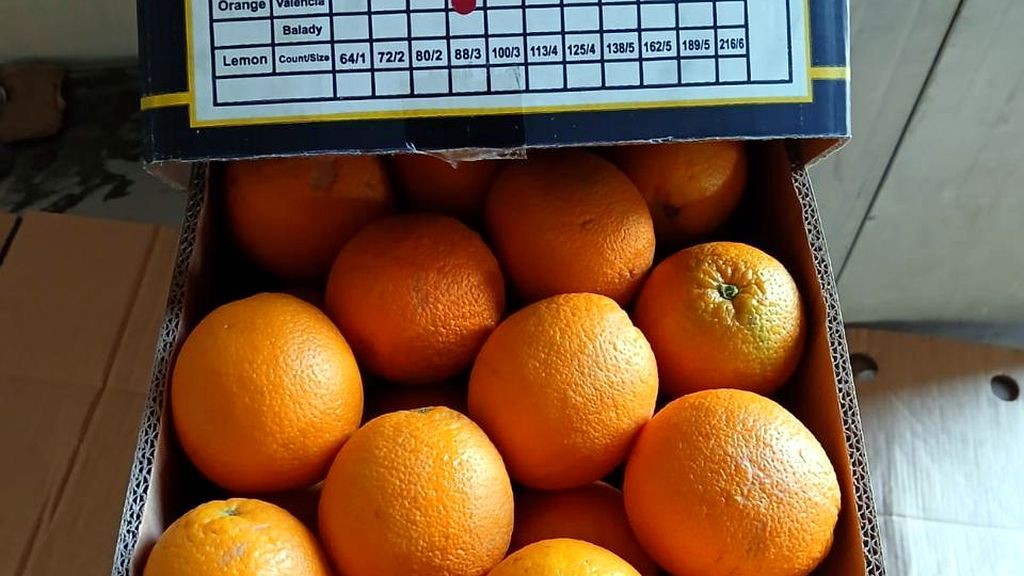
| Oranges | 0805.10 | Count per carton is declared on the invoice |
| Mandarins | 0805.21 | A separate heading from oranges |
| Lemons and limes | 0805.50 | The same heading covers both |
| Dry white beans | 0713.33 | Declared by species, not by trade name |
| Fava / broad beans | 0713.50 | Hulled and unhulled differ at 8-digit level |
| Chickpeas | 0713.20 | On request |
| Short-grain rice | 1006.30 | Broken percentage affects classification |
| Fresh onions | 0703.10 | Season and calibre on the invoice |
| Shelled groundnuts | 1202.42 | Increased controls for aflatoxins — see section 4 |
3. EU–Egypt preferential treatment
Egypt has an Association Agreement with the European Union, which means preferential tariff treatment for a significant share of agricultural products — some duty-free, others within annual tariff quotas.
The preference is not automatic. Origin must be proven, by an EUR.1 movement certificate issued in Egypt or, below a value threshold, by an invoice declaration from an approved exporter. If the exporter does not send you the EUR.1, you pay full duty — and recovering it afterwards is not easy.
Ask for EUR.1 in the contract, not by email after loading. It is the document exporters most often forget, and the only one that cannot be issued retroactively without complications.
Quotas are reviewed annually. Check the exact heading in TARIC, the European Commission's tariff database, before you calculate a selling price — a wrongly assumed duty eats the margin on the whole container.
4. Increased controls: where lots get held
Certain products of non-animal origin from certain countries are subject to an increased frequency of controls at the EU point of entry, under Regulation (EU) 2019/1793. The list is updated periodically, and for Egypt the most relevant historical entry is groundnuts, for aflatoxins.
In practice this means: presentation at a border control post, possible sampling, and goods held until the laboratory result. Add 5 to 15 days to the lead time and the cost of analysis to the budget.
- Ask for a certificate of analysis from origin for every lot, not for every order.
- Check whether your heading is on the current list before promising a date to the end customer.
- For products under increased controls, do not schedule delivery to the customer in the same week the vessel arrives.
5. Documents that must exist
| Document | Issued by | Without it |
|---|---|---|
| Commercial invoice | The exporter | Customs value cannot be declared |
| Packing list | The exporter | The lot cannot be verified at physical control |
| Bill of lading | The shipping line | Goods cannot be released from the terminal |
| Certificate of origin / EUR.1 | Chamber of commerce / Egyptian customs | Tariff preference is lost |
| Phytosanitary certificate | Egyptian phytosanitary authority | Plant products cannot enter the EU |
| Certificate of analysis | Accredited laboratory | Held at increased controls |
| Food-contact material declaration | The packaging manufacturer | Required for food packaging |
6. Labelling for the Romanian market
The label must be in Romanian and compliant with Regulation (EU) No 1169/2011: product name, ingredient list, allergens highlighted, net quantity, date of minimum durability, storage conditions, the name and address of the EU operator placing the product on the market, country of origin and the nutrition declaration.
The EU operator on the label is you, not the Egyptian exporter. This is the most common first-shipment mistake: the goods arrive correctly labelled in English and Arabic, and cannot go on a shelf.
The cheapest solution is labelling at origin, with the label approved by you before production. Relabelling in Romania costs a few cents per unit plus labour and space.
7. Realistic timelines
| Stage | Indicative duration |
|---|---|
| Offer and specification negotiation | 2–5 days |
| Production / lot preparation | 7–21 days |
| Loading and formalities at origin | 3–7 days |
| Sea transit Alexandria → Constanța | 10–14 days |
| Clearance without physical control | 1–3 days |
| Clearance with sampling | +5–15 days |
| Inland transport to warehouse | 1–2 days |
A realistic first import is 30 to 50 days from order confirmation to goods in the warehouse. Anyone promising two weeks either has the goods already in stock in Europe, or has never done it.
8. How payment usually works
On a first import with a new supplier, the norm is a partial advance on order and the balance against documents. A documentary letter of credit gives the best protection but costs money and slows things down; for single containers it is rarely justified.
The practical rule: do not pay in full before loading to a supplier you have not worked with, and do not accept goods without the documents in section 5, however good the price looks.